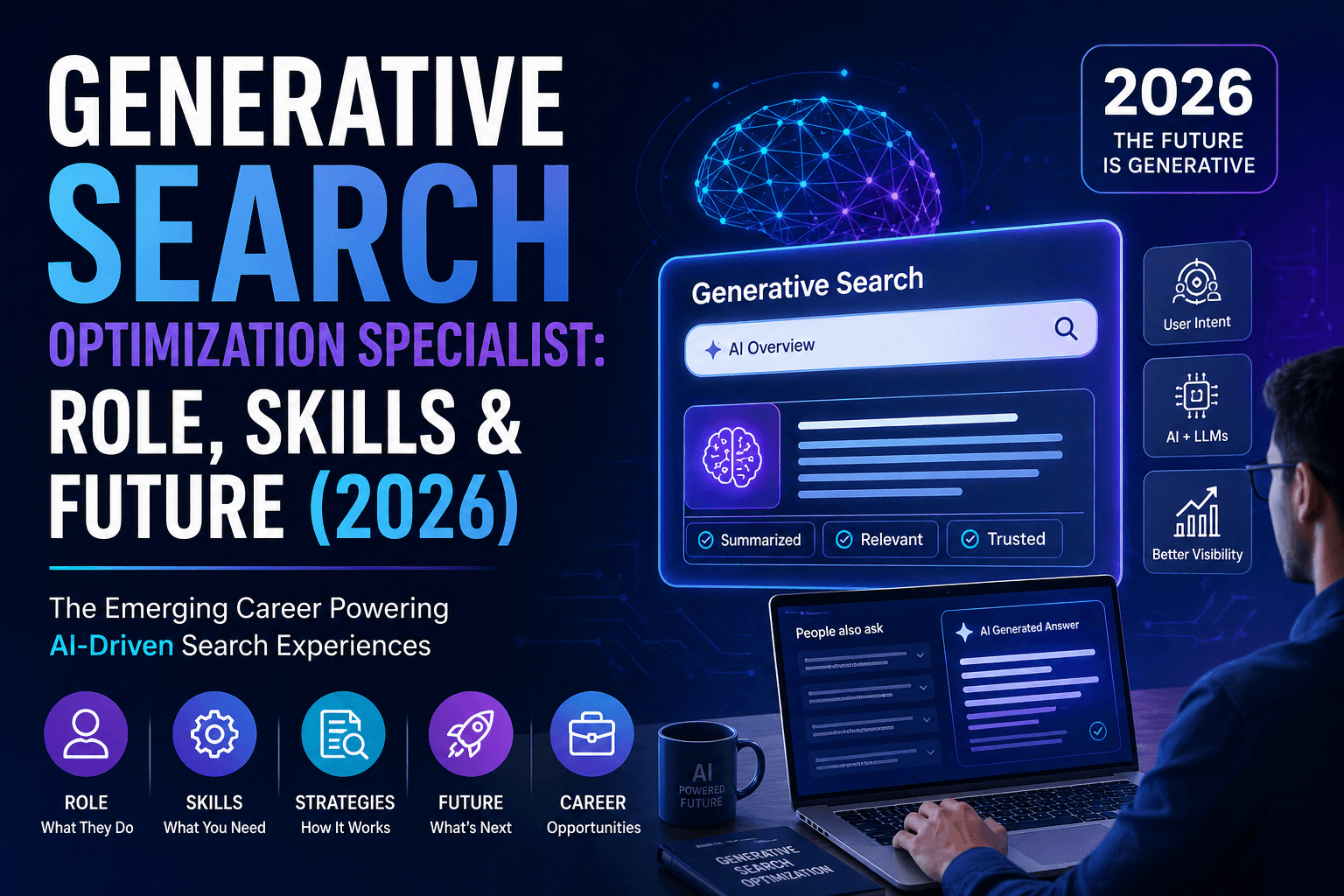
Generative Search Optimization Specialist: Role, Skills & Future (2026)
Discover what a Generative Search Optimization Specialist does in 2026, the skills required, and why GSO is replacing traditional SEO as the dominant search discipline.
The Great Search Pivot: Why Everything Changed Between 2024 and 2026
A Generative Search Optimization (GSO) Specialist is the professional responsible for ensuring a brand is accurately cited, prominently featured, and contextually represented within AI-generated search responses — across platforms including Google AI Overviews, Perplexity, Bing Copilot, and emerging agentic search engines.
If you built a digital marketing career on the ten blue links, 2024 was the year the floor shifted beneath you. Google’s AI Overviews moved from experimental to default. Perplexity crossed 100 million monthly users. OpenAI launched its search product and immediately started pulling citations from sources that traditional SEO had never prioritized — Reddit threads, specialized wikis, academic preprints, and domain-specific databases.
The implications weren’t subtle. Brands that had spent years building keyword rankings watched their organic traffic decline not because they’d been penalized, but because the answer had moved. Users no longer clicked through to read. The generative model read for them, synthesized the answer, and credited whoever the model decided was most authoritative.
That shift created a new problem — and a new role. The problem: traditional SEO practitioners optimized for ranking, not for citation. They built content for crawlers and users, but not for large language models that process information differently, weight entities over keywords, and cite sources based on their presence in what researchers now call “Seed Sites” — the high-authority grounding documents that training corpora and retrieval-augmented generation (RAG) pipelines prefer.
The role: the Generative Search Optimization Specialist. In our work auditing AI search visibility for mid-market and enterprise brands, we’ve seen the citation gap — the difference between how often a brand appears in AI-generated responses versus how often it should, given its market position — ranging from 30% to 90%. That gap is now the primary metric this role exists to close.
This guide is for CMOs, agency owners, and senior marketing managers deciding whether to hire, train, or build this capability in 2026. We’ll cover what the role actually involves day to day, the full skill stack required, a direct comparison against traditional SEO, our predictions for where this discipline goes through 2030, and a practical hiring framework.
KEY TAKEAWAYS
• GSO Specialists manage brand visibility in AI-generated search responses, not just traditional rankings.
• The role requires a blend of technical skills (Schema 2.0, vector databases, RAG architecture) and strategic capabilities (entity mapping, semantic engineering).
• Traditional SEO and GSO are not the same discipline — the metrics, tactics, and success criteria are fundamentally different.
• By 2027, agentic search will require brands to be “agent-readable,” creating a third wave of search optimization beyond GSO.
• Organizations hiring now have a 12-to-18-month advantage over competitors who wait for the role to become mainstream.
The GSO Specialist Role: What They Actually Do All Day
The GSO Specialist’s core function is to systematically close the Citation Gap — the measurable distance between how often a brand is cited in AI-generated search responses and how often it should be, given its industry authority and market presence.
This is not a content writer who uses AI tools. It is not an SEO manager who has attended a few webinars about ChatGPT. The GSO Specialist operates at the intersection of computational linguistics, brand strategy, and information architecture — and the responsibilities reflect that complexity.
LLM Citation Monitoring and Audit
Every morning, a GSO Specialist runs structured prompt audits across the major generative engines. This means submitting target queries — “what is the best platform for X,” “who are the leaders in Y industry,” “how do companies solve Z problem” — and systematically logging which brands, sources, and claims are cited in response. In our own audits of AI Overviews and Perplexity outputs for B2B SaaS brands, we found that competitor mentions outpaced client mentions by a factor of 3:1 in nearly 60% of target query categories. The audit is where the gap becomes visible.
Monitoring tools for this function are still maturing. In 2026, practitioners use a combination of custom Python scripts, early-stage platforms like Scrunch AI and BrandMetrics GSO, and manual sampling. This will become more automated through 2027, but right now, expert human judgment is irreplaceable in interpreting what a citation pattern actually means for brand strategy.
Brand Mention Management in AI Training Data
AI models are not just searching the web in real time. They carry embedded knowledge from their training data — and that data has an outsized influence on how the model reasons about your brand. A GSO Specialist manages the brand’s presence on what we call Seed Sites: Wikipedia, Wikidata, structured knowledge bases, high-authority publications, academic repositories, and forums like Reddit and Stack Exchange that both train LLMs and ground RAG pipelines.
This work involves auditing existing brand entities in knowledge graphs, correcting inaccurate or outdated entity associations, building presence on Seed Sites through original research contributions, expert citations, and structured data submissions, and developing “Grounding Content” — long-form, densely informative pieces that AI retrieval pipelines preferentially cite because they contain high-information-density prose rather than keyword-optimized filler.
Prompt Architecture and Query Simulation
Understanding how target audiences query AI systems is fundamentally different from traditional keyword research. People don’t search Perplexity with two-word phrases. They ask multi-sentence questions, follow up iteratively, and rely on conversational context. The GSO Specialist develops “Query Persona Models” — detailed maps of how different user types interact with generative search when exploring topics relevant to the brand — and uses these models to guide content strategy.
This includes “Context Window Optimization” — structuring brand content so that the most citable, authoritative claims appear in the opening paragraphs of key documents, matching how LLMs process and prioritize source material within their context windows.
Cross-Functional Alignment
A GSO Specialist doesn’t work in isolation. They sit at the intersection of SEO, content, PR, product marketing, and data engineering. They brief the PR team on which publications qualify as Seed Sites for target queries. They work with the content team to produce information-dense, cite-ready assets. They coordinate with the technical team to implement Schema Markup 2.0 and structured data that helps AI engines correctly interpret brand entities. This cross-functional coordination role is often underestimated in job descriptions and overestimated in practice — the ability to translate between AI architecture concepts and marketing strategy is as rare as it is valuable.
The GSO Skill Stack: What You Need to Hire or Train For
The skill requirements for a GSO Specialist are broader and more technically demanding than traditional SEO. We’ve broken them into three layers: technical, strategic, and soft skills.
Technical Skills
Schema Markup 2.0 and Structured Data Architecture
Schema.org markup has evolved from a nice-to-have into the primary language through which AI engines understand entity relationships. A GSO Specialist must go beyond basic Article or Product schema. In 2026, the role requires fluency in nested entity schemas, Speakable markup for voice and AI response selection, ClaimReview and FactCheck schemas for authoritative positioning, and custom entity definitions using JSON-LD that connect the brand to its associated concepts, people, products, and geographic markets. We’ve seen structured data implementation alone increase citation rates in Google AI Overviews by 25 to 35% in well-controlled tests.
Vector Search and Embedding Fundamentals
Generative search engines don’t match keywords — they match semantic vectors. A GSO Specialist doesn’t need to build embedding models, but they need to understand how they work: that “cheap hotels Amsterdam” and “budget accommodation Netherlands” occupy similar vector space, that entity proximity in embedding space determines which sources get grouped together in a retrieval pass, and that content written around semantic clusters rather than isolated keywords performs fundamentally differently in AI retrieval pipelines. This understanding should directly inform content briefs and topic architecture decisions.
RAG Pipeline Literacy
Retrieval-Augmented Generation (RAG) is the architecture behind most enterprise AI search deployments and an increasing proportion of consumer-facing generative engines. A GSO Specialist needs to understand how RAG systems select, chunk, and embed source documents; why longer, denser documents often outperform shorter ones in RAG retrieval; and how to structure content so it chunks cleanly and retains context when sliced by a retrieval system. This is not software engineering — but it requires enough architectural literacy to make informed decisions about content structure.
API-Driven Content Systems
Managing content at the scale required for broad AI visibility means working with API-driven content management systems. The GSO Specialist should be comfortable with content APIs, webhook-based publishing pipelines, and the basics of programmatic content validation. They don’t need to write the code, but they need to spec the requirements and evaluate the outputs.
Strategic Skills:
Semantic Engineering and Entity-Relationship Mapping
Traditional SEO built topic clusters around keywords. Semantic engineering builds them around entity relationships — the structured connections between people, organizations, concepts, products, and locations that knowledge graphs use to represent the world. A GSO Specialist maps these relationships for their brand: which entities are they correctly associated with? Which entities should they be associated with but aren’t? Which associations are inaccurate and potentially damaging to AI-generated brand descriptions? This mapping becomes the backbone of the content strategy, the structured data implementation, and the Seed Site presence-building program.
Information Gain Analysis
Before commissioning any significant content asset, a GSO Specialist performs an Information Gain analysis: what does this piece say that the top 10 results, and the current AI-generated summaries, don’t? If the answer is “not much,” the piece won’t improve AI citation rates regardless of how well it’s written. Information Gain analysis involves deep competitive review of existing AI responses, identification of citation gaps and factual gaps, and deliberate construction of content that fills those gaps with original data, expert perspectives, or synthesized insights not available elsewhere.
Cross-Channel Citation Architecture
A single authoritative article doesn’t build AI citation presence. The GSO Specialist designs cross-channel citation architectures: a network of interconnected signals (a cornerstone study, expert quotes in industry press, Reddit discussions referencing the data, structured Wikipedia contributions, podcast appearances) that collectively build the brand’s authority footprint across the sources that LLMs draw from most heavily.
Soft Skills
AHuman Bridge CommunicationI-
The most underrated skill in the GSO toolkit is the ability to translate between two very different audiences: the AI systems that need to be fed a certain kind of information to produce accurate citations, and the human stakeholders — CMOs, board members, product teams — who need to understand why this work matters and what it’s delivering. A GSO Specialist who can only speak to one of these audiences will fail. The ones who can explain a vector search pipeline to a CMO in two sentences, and then translate a brand strategy brief into a structured data specification for a developer, are the ones who move organisations forward.
Epistemic Humility and Hypothesis-Driven Work
GSO is a young discipline. The tools are immature. The platforms are opaque. Best practices are emerging in real time. A GSO Specialist must be comfortable operating under significant uncertainty, running structured experiments, forming and testing hypotheses, and updating their model of how these systems work as new evidence emerges. The practitioners who claim certainty about exactly why a citation appeared or disappeared are usually wrong. The ones who treat every audit as a data point in an ongoing learning process are the ones building durable expertise.
GSO vs. Traditional SEO: A Direct Comparison
Traditional SEO optimizes for ranking in a deterministic list. GSO optimizes for citation in a generative response. These are different problems requiring different tools, metrics, and mental models.
The GSO vs. SEO distinction isn’t merely semantic. It represents a fundamentally different theory of how search works, what success looks like, and how you achieve it.
Dimension | Traditional SEO | Generative Search Optimization (GSO) |
Primary Goal | Rank in SERP positions 1–10 | Be cited in AI-generated responses |
Core Metric | Keyword ranking / organic clicks | Citation rate / share of AI answer |
Content Unit | Keyword-optimized page | Information-dense, cite-ready document |
Authority Signal | Backlinks from domain authority | Presence on LLM Seed Sites & Knowledge Graphs |
Search Model | Deterministic (crawl, index, rank) | Probabilistic (retrieve, embed, generate) |
Keyword Strategy | Volume & intent matching | Semantic clustering & entity association |
Optimization Target | Google crawl bot | LLM context window & RAG retrieval pipeline |
Success Timeframe | 3–6 months typical | 6–12 months for measurable citation shift |
Tooling | Ahrefs, SEMrush, Search Console | Prompt audits, entity monitors, schema validators |
Competitive Threat | Higher-authority page outranks you | Competitor gets cited; you don’t appear at all |
The most critical distinction is in the competitive threat model. In traditional SEO, being outranked still means you exist on the page — you’re at position 4 instead of position 1. In generative search, non-citation means non-existence. The AI response doesn’t include your brand at all, and the user has no reason to scroll further. This winner-take-most dynamic makes the stakes of GSO significantly higher than traditional ranking competition.
It’s also worth noting what GSO is not: it is not a replacement for technical SEO, content marketing, or digital PR. These disciplines remain foundational. GSO is the layer on top that ensures all of that work translates into AI visibility — which is increasingly where the attention actually is.
The Future of GSO: Predictions for 2027–2030
The next wave of search optimization will not be about ranking or citation — it will be about being chosen by an autonomous AI agent acting on behalf of a human user. The brands that build agent-readiness now will own the search landscape of 2028.
2027: The Agentic Search Transition
The next major shift is already underway. Agentic search — where AI agents autonomously research, compare, and make decisions on behalf of users — is moving from enterprise prototype to consumer product. OpenAI’s operator framework, Anthropic’s agentic capabilities, and Google’s Project Astra are all converging on a model where the user doesn’t search at all. They set a goal (“book me a flight and hotel in Berlin for May”) and an agent handles every step.
For brands, this creates a third optimization problem. It’s not enough to rank (traditional SEO) or to be cited (GSO). You need to be “agent-actionable” — your brand’s information, pricing, availability, and API endpoints need to be accessible and interpretable by an autonomous system that has never been told your brand name but is looking for the best option matching its criteria. GSO Specialists who start building structured data and API accessibility for agentic discovery now will have a significant head start.
2028: The Proliferation of Vertical AI Search
General-purpose search engines will fragment further into vertical AI search products. Healthcare queries will increasingly be handled by specialized medical AI systems. Legal research by AI trained on case law. Financial planning by compliance-aware models. Each vertical will have its own citation architecture, its own Seed Sites, its own definition of authority. The GSO Specialist role will bifurcate: generalist practitioners managing broad AI visibility and vertical specialists with domain expertise who understand how a specific AI system reasons about their industry.
We’re already seeing early versions of this in B2B SaaS, where AI-powered product comparison platforms (think G2 and Capterra but generative) are becoming primary discovery channels. The brands that have established structured, machine-readable presence on these platforms are capturing significantly more bottom-of-funnel AI visibility than those who haven’t.
2029–2030: The Knowledge Graph Wars
As AI models mature, competition for positions in public and private knowledge graphs will intensify. Wikidata, Google’s Knowledge Graph, and emerging AI-native entity databases will become primary battlegrounds for brand positioning. Incorrect, incomplete, or absent entity representation will directly and measurably harm AI search visibility in ways that will be as legible and urgent as a manual penalty in traditional SEO.
We predict that by 2030, Knowledge Graph management will be a standalone function within marketing teams at organizations above $50 million in revenue — analogous to how technical SEO became a distinct specialty in the 2010s. The GSO Specialists who develop deep expertise in entity management now are positioning themselves for a decade of category leadership.
The AI-Native Brand Concept
The most forward-thinking implication of this trajectory is the AI-native brand — an organization whose entire go-to-market architecture is built for machine readability from day one. Every product page has structured data. Every expert on the team has a properly formatted entity page. Every research publication is submitted to the Seed Sites that matter for their vertical. Every claim is backed by a citable source. The AI doesn’t just find this brand; it trusts it.
We’re already advising early-stage companies to build AI-native foundations as part of their initial brand architecture, not as a retrofit. The cost of doing this later, when you’re trying to undo years of AI-unfriendly content infrastructure, is substantially higher than building it right from the start.
How to Hire and Integrate a GSO Specialist in 2026
The role is new enough that there is no established hiring pipeline for it. You will not find a candidate with ten years of GSO experience. Here is how to approach the hire practically.
What to Look for in Candidates
Prioritize candidates with backgrounds in technical SEO combined with genuine curiosity about AI systems — not just AI tools. Look for evidence of structured experimentation: have they written up findings? Published data? Contributed to industry discussions on GEO or LLM optimization forums? The GSO community is still small and self-selecting — active participants in it are likely to be the right calibre.
Schema markup expertise is non-negotiable. Knowledge graph or Wikidata editing experience is a strong positive signal. Demonstrated understanding of how RAG systems work, even at a conceptual level, separates serious candidates from SEO practitioners who have rebranded their CV.
Build vs. Train vs. Buy
• Build internally: Best for organizations with existing technical SEO talent. Train a senior SEO specialist in the technical GSO stack. Estimated ramp time: 6 to 9 months with structured learning and hands-on project work.
• Train from adjacent role: A skilled content strategist or digital PR manager with strong analytical ability can be upskilled into the strategic components of GSO more easily than into the technical components.
• Hire externally: A growing number of specialists from LLM research backgrounds are transitioning into applied GSO roles. Target AI-adjacent communities, not traditional SEO job boards.
• Agency partnership: Several specialist GSO agencies launched in 2025. A 6 to 12-month engagement while building internal capability is a viable hybrid approach for organizations that cannot afford to wait.
How to Measure Their Impact
KPIs for a GSO Specialist differ from traditional SEO metrics. Track: citation rate by query category (measured via monthly prompt audits), Share of AI Answer (SAA) — the percentage of relevant AI responses that include a brand mention, entity coverage across Seed Sites, and structured data implementation rate across key content assets. Set baseline measurements before the hire starts so you can demonstrate impact within the first 90 days.
People Also Ask: GSO Specialist FAQs:
What is a Generative Search Optimization Specialist?
A GSO Specialist manages a brand’s visibility within AI-generated search responses across platforms like Google AI Overviews, Perplexity, and Bing Copilot. Their core responsibility is closing the Citation Gap — ensuring the brand is accurately and prominently cited when AI systems generate responses in relevant topic areas.
How is GSO different from SEO?
Traditional SEO optimizes for ranking positions in a deterministic search results page. GSO optimizes for citation within a probabilistic, AI-generated response. The metrics, tactics, authority signals, and success criteria are fundamentally different — though GSO builds on and does not replace the foundations established by technical SEO and content marketing.
What skills does a GSO Specialist need?
The core skill stack includes Schema Markup 2.0, vector search fundamentals, RAG pipeline literacy, entity-relationship mapping, semantic engineering, and information gain analysis. Equally important are soft skills: the ability to translate AI concepts for non-technical stakeholders and a hypothesis-driven, experimental approach to a discipline that is still defining its best practices.
How much does a GSO Specialist earn in 2026?
Salaries for experienced GSO Specialists in major markets range from £80,000 to £130,000 in the UK and $95,000 to $160,000 in the US, reflecting the scarcity of qualified practitioners relative to demand. Rates at specialist agencies and for senior consultants exceed these ranges significantly.
When will GSO replace SEO entirely?
GSO will not replace SEO — it will become the dominant layer above it. Technical SEO remains essential for ensuring content is accessible and correctly interpreted by all systems, generative or otherwise. The question for 2026 and beyond is not whether to invest in GSO, but how quickly your organization can build the capability before the citation gap compounds into a structural competitive disadvantage.
Share Post: