How to Optimize Any CMS Website for SEO in 2026
An In-Depth Look at How Digital Agencies Strategically Transform Online Presence with Creative Branding, UX-Centered Design, SEO, Content Strategy, and Data-Led Marketing to Empower Businesses.
Feb 9, 2025
20-25 Minutes
How to Optimize Any CMS Website for SEO in 2026
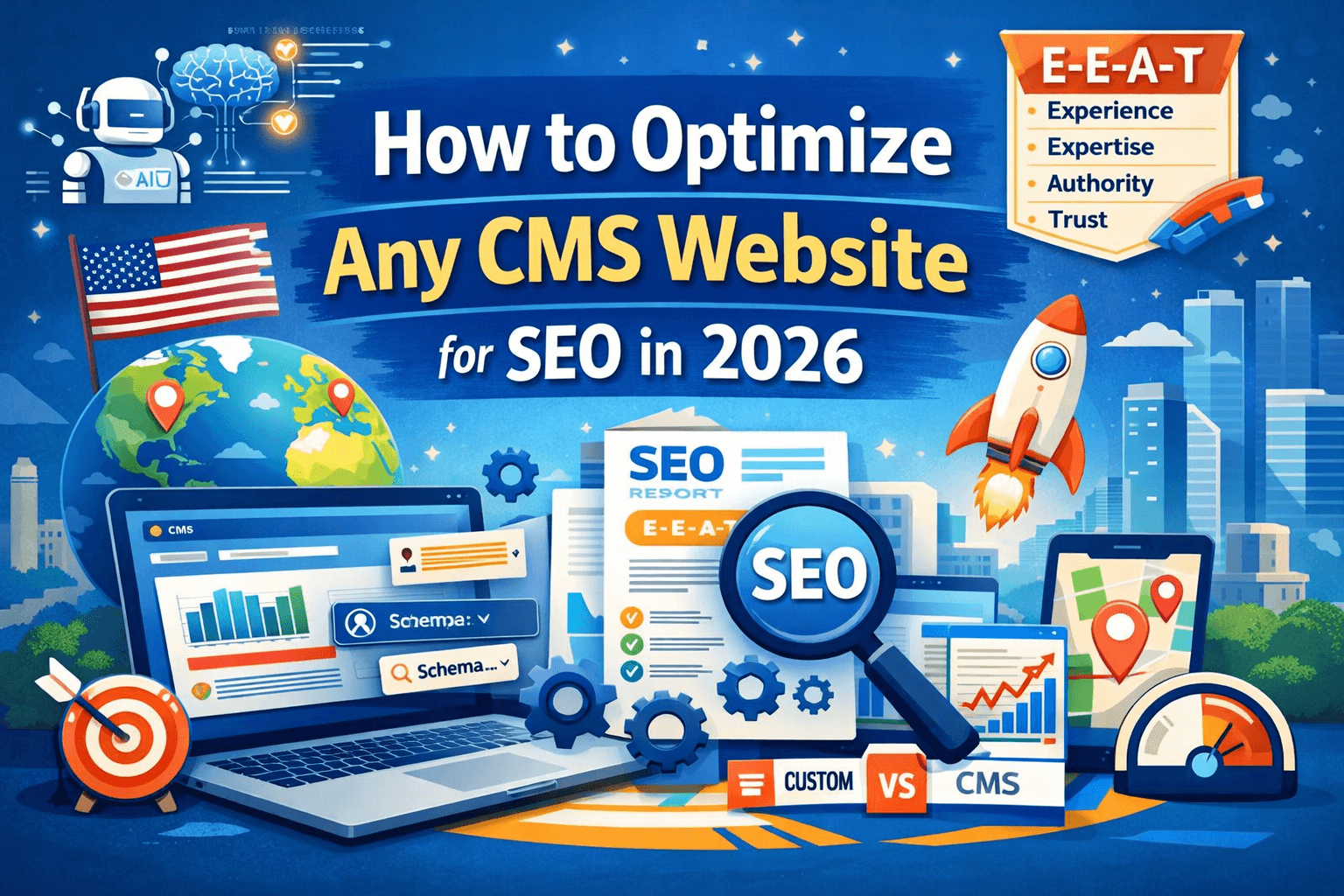
Search engine optimization in 2026 looks very different from what it did even a few years ago. Search engines no longer reward websites simply for publishing keyword-stuffed content or acquiring random backlinks. Instead, they evaluate experience, expertise, trust, geographic relevance, and real user value.
Content Management Systems (CMS) such as WordPress, Shopify, Drupal, Joomla, Wix, and headless CMS platforms now sit at the center of this evolution. They are powerful, flexible, and scalable — but only when optimized correctly. A poorly optimized CMS can limit visibility, while a well-optimized one can dominate search results across multiple countries and industries.
This article explores how to optimize any CMS website for SEO in 2026, focusing on modern SEO principles, EEAT, geo-targeting, platform comparisons, expertise requirements, and real-world examples.
The Changing Nature of SEO in 2026
SEO in 2026 is driven by context rather than keywords. Search engines use advanced AI models to understand:
What a page is truly about
Who created it and why
Whether the information is trustworthy
How relevant it is for a specific user and location
For CMS websites, this means SEO is no longer a single plugin or setting. It is an ecosystem that combines technical structure, content depth, user experience, and credibility signals.
Keywords in 2026: From Search Terms to Search Intent
Keywords still matter, but their role has changed. In 2026, search engines prioritize search intent and topical relevance over exact-match phrases.
A CMS website should be structured around:
Core topics (pillar pages)
Supporting subtopics
Semantic keyword variations
Entity relationships
For example, instead of targeting one keyword like “CMS SEO”, a modern CMS page should naturally cover:
CMS SEO optimization
Technical SEO for CMS platforms
EEAT implementation in CMS
Geo-targeted SEO strategies
This approach allows CMS websites to rank for hundreds of related queries from a single, well-optimized content cluster.
EEAT: The Foundation of SEO Trust in 2026

EEAT (Experience, Expertise, Authoritativeness, Trustworthiness) is one of the most critical ranking factors in 2026 — especially for business, marketing, finance, healthcare, and ecommerce websites.
How CMS Websites Build EEAT:
CMS platforms make EEAT implementation more accessible by allowing:
Author profile pages with credentials and experience
Clear editorial and review processes
Structured data for authors, organizations, and reviews
Easy integration of testimonials, case studies, and client logos
A CMS website that clearly shows who created the content, why they are qualified, and how users can trust them will consistently outperform anonymous or generic websites.
Geographic SEO: Ranking Where It Matters Most
Search results in 2026 are deeply influenced by location signals. The same CMS website can rank differently in different countries, even for identical search queries.
Why Geo-Targeting Is Essential
CMS websites often serve:
Multiple countries
Multiple languages
Region-specific audiences
To succeed, they must implement:
Country-specific content
hreflang tags
Localized structured data
Region-relevant backlinks and citations
Country-Wise SEO Focus
In the United States, SEO heavily favors authority, brand signals, and EEAT.
In India, multilingual content and regional relevance play a significant role.
In Europe, especially Germany and the UK, data privacy, performance, and trust are key ranking signals.
In Middle Eastern markets, bilingual content and local business optimization matter most.
CMS platforms provide the flexibility needed to manage these variations efficiently.
Custom Websites vs CMS Websites: An SEO Perspective
Aspect | Custom Website | CMS Website |
|---|---|---|
SEO Scalability | Limited | High |
Content Publishing Speed | Slow | Fast |
EEAT Implementation | Manual | Structured |
Geo SEO Support | Complex | Built-in |
Maintenance | High effort | Easier |
Cost Efficiency | Expensive | Cost-effective |
In 2026, CMS websites are often the better SEO choice — not because they are simpler, but because they allow structured optimization at scale.
Essential SEO Elements for CMS Websites
Technical SEO
CMS websites must be technically clean:
Fast loading speeds
Mobile-first design
Proper indexing and crawl control
Secure HTTPS implementation
Optimized Core Web Vitals
On-Page and Content SEO
Content should be:
Written for real users, not algorithms
Structured with clear headings and internal links
Updated regularly to maintain freshness
Supported by visuals, examples, and data
Structured Data and Schema
In 2026, structured data helps search engines understand content context. CMS platforms support schema for:
Articles and blogs
Products and services
FAQs and reviews
Local businesses and organizations
Real-World CMS SEO Examples
WordPress dominates content-driven SEO due to its flexibility and plugin ecosystem.
Shopify excels in ecommerce SEO when optimized for speed and structured product data.
Drupal is preferred by large enterprises that require advanced technical SEO control.
Headless CMS platforms are growing rapidly for performance-focused, global websites.
Each CMS has strengths, but SEO success depends on how strategically it is configured.
Expertise Required for CMS SEO in 2026
SEO optimization for CMS websites now requires a blend of skills:
Technical SEO knowledge
Content strategy and topical authority planning
Understanding of AI-driven search behavior
Data analysis and performance measurement
Geo-targeting and localization expertise
SEO is no longer a one-person job; it is a collaborative process between strategists, writers, developers, and analysts.
Benefits of CMS SEO Optimization
When optimized correctly, CMS websites benefit from:
Higher organic visibility
Faster content scaling
Improved trust and credibility
Stronger conversion performance
Lower long-term marketing costs
These benefits compound over time, making CMS SEO one of the highest-ROI digital strategies in 2026.
“Your brand is what other people say about you when you're not in the room. In the digital world, your online presence speaks for you” — Jeff Bezos
Comparison: How Different CMS Types Handle Structure
Not all platforms are created equal. The table below compares the inherent structural challenges of the three main CMS categories.
Feature | Traditional Monolith (WordPress, Drupal) | SaaS / eCommerce (Shopify, Wix, Squarespace) | Headless / Decoupled (Contentful, Strapi, Sanity) |
URL Structure | High Flexibility: Can be fully customized (e.g., | Rigid: Forced directories like | Total Control: URLs are defined manually in the frontend code. |
Taxonomy Risk | High: Prone to "Tag Bloat" (thousands of thin tag pages). | Low: usually flatter, but filtering parameters can cause duplicate content. | Medium: Requires manual logic to build category pages. |
Internal Linking | Plugin Dependent: Easy to automate, but risk of spammy links. | Template Bound: Often siloed (hard to link from product to blog). | ** programmatic:** Links must be coded into the content model. |
Ideal For | Content-heavy sites, News, Publishers. | Pure eCommerce, D2C Brands. | Enterprise, Omnichannel experiences. |
Final Thoughts
Optimizing a CMS website for SEO in 2026 is about building a trustworthy digital presence, not chasing rankings. Search engines reward websites that demonstrate real expertise, provide meaningful experiences, and serve users in the right context and location.
A CMS, when aligned with modern SEO principles, becomes more than a content platform — it becomes a growth engine.
Share Post: